Bubble Sort:
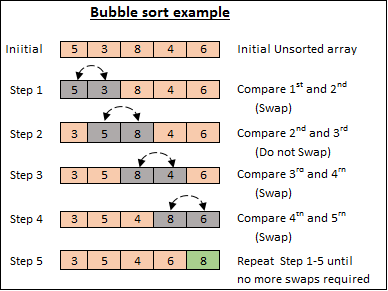
- It repeatedly steps through the list, compares adjacent elements, and swaps them if they are in the wrong order.
- The pass through the list is repeated until the list is sorted.
- In each iteration, the largest unsorted element “bubbles up” to its correct position.
Selection Sort:
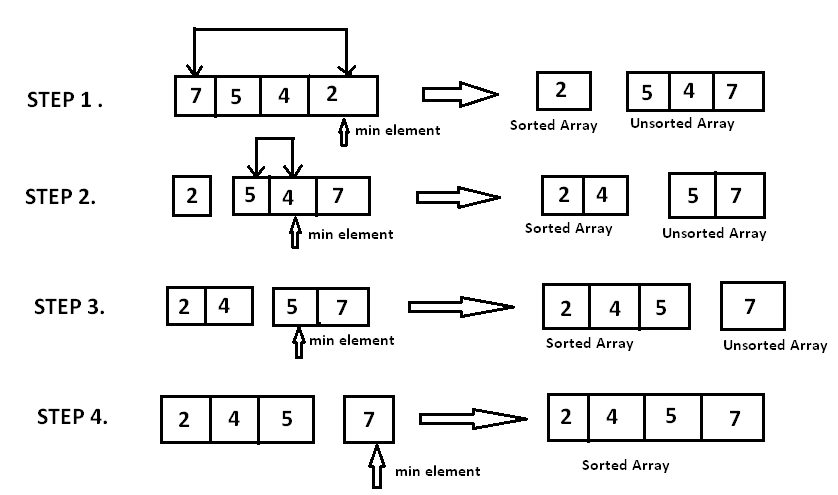
- It divides the input list into two parts: the sorted and the unsorted sublists.
- Initially, the sorted sublist is empty, and the unsorted sublist contains all the elements.
- It repeatedly finds the smallest element from the unsorted sublist and moves it to the end of the sorted sublist.
- The algorithm continues this process until the unsorted sublist becomes empty.
Insertion Sort:
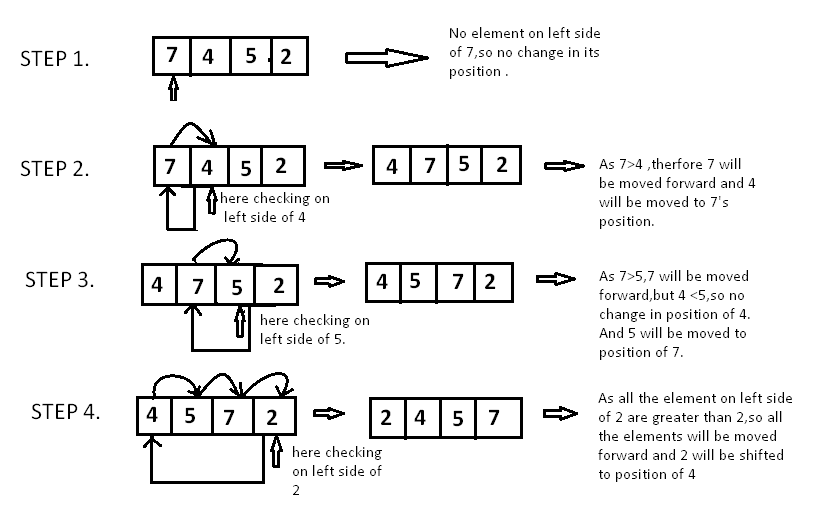
- It builds the final sorted list one element at a time.
- It takes one element from the input data and places it in its correct position within the sorted list.
- It iterates through the remaining elements, shifting them to the right if they are larger than the current element being sorted.
Merge Sort:
.png)
- It is a divide-and-conquer algorithm that divides the input list into two halves, recursively sorts each half, and then merges them.
- It divides the list until it cannot be further divided (i.e., it has one or zero elements).
- It then merges the smaller sorted lists into larger sorted lists until the entire list is sorted.
Quick Sort:
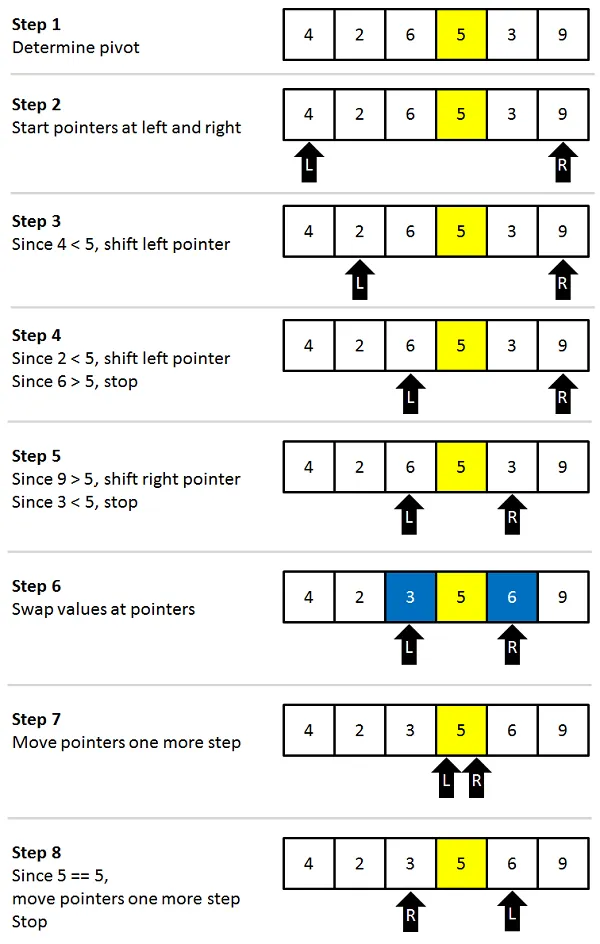
- It is also a divide-and-conquer algorithm that partitions the input list into two parts around a pivot element.
- It selects a pivot element from the list and partitions the other elements into two sublists: one with elements less than the pivot and one with elements greater than the pivot.
- It then recursively applies the same process to the sublists until the entire list is sorted.
- It’s worth noting that the choice of pivot can greatly affect the performance of the algorithm; the implementation here uses the last element as the pivot for simplicity.
Code in Demostration with Generic T Lists (Collectables):
public class TList<T extends Comparable<T>> { // Defining a generic class TList with a type parameter T that extends Comparable<T>
    private List<T> list; // List to store elements of type T

    public TList() { //Constructor to initialize the list as an ArrayList
        list = new ArrayList<>();
    }

    public void add(T item) { //Simple method to add an element to the list
        list.add(item);
    }

    public void bubbleSort() {//Bubble sort algorithm to sort the list
        int n = list.size();
        // Traverse through the list
        for (int i = 0; i < n - 1; i++) { //iterates through everything but last index to prevent out of bounds exception
            for (int j = 0; j < n - i - 1; j++) { //sorts the list the amount of times the list is needed to sorted
                if (list.get(j).compareTo(list.get(j + 1)) > 0) { //compare adjacent elements and swap if necessary
                    T temp = list.get(j); //setting up temporary variable
                    list.set(j, list.get(j + 1)); //swapping variables
                    list.set(j + 1, temp);
                }
            }
        }
    }

    public void selectionSort() {// Selection sort algorithm to sort the list
        int n = list.size();
        // Traverse through the list
        for (int i = 0; i < n - 1; i++) {
            int minIndex = i;
            // Find the index of the minimum element in the unsorted portion
            for (int j = i + 1; j < n; j++) {
                if (list.get(j).compareTo(list.get(minIndex)) < 0) {
                    minIndex = j;
                }
            }
            // Swap the minimum element with the first element of the unsorted portion
            if (minIndex != i) {
                T temp = list.get(i);
                list.set(i, list.get(minIndex));
                list.set(minIndex, temp);
            }
        }
    }

    // Insertion sort algorithm to sort the list
    public void insertionSort() {
        int n = list.size();
        // Traverse through the list
        for (int i = 1; i < n; ++i) {
            T key = list.get(i);
            int j = i - 1;
            // Move elements of list[0..i-1], that are greater than key, to one position ahead of their current position
            while (j >= 0 && list.get(j).compareTo(key) > 0) {
                list.set(j + 1, list.get(j));
                j = j - 1;
            }
            list.set(j + 1, key);
        }
    }

    // Merge sort algorithm to sort the list
    public void mergeSort() {
        // Create a temporary list to perform merge sort
        List<T> temp = new ArrayList<>(list);
        mergeSortHelper(temp, 0, list.size() - 1);
    }

    // Helper method for merge sort algorithm
    private void mergeSortHelper(List<T> arr, int left, int right) {
        if (left < right) {
            int middle = (left + right) / 2;
            // Recursively sort the left and right halves
            mergeSortHelper(arr, left, middle);
            mergeSortHelper(arr, middle + 1, right);
            // Merge the sorted halves
            merge(arr, left, middle, right);
        }
    }

    // Method to merge two sorted sublists
    private void merge(List<T> arr, int left, int middle, int right) {
        int n1 = middle - left + 1;
        int n2 = right - middle;

        // Create temporary lists to hold the elements of the two sublists
        List<T> L = new ArrayList<>();
        List<T> R = new ArrayList<>();

        // Copy data to temporary lists L[] and R[]
        for (int i = 0; i < n1; ++i)
            L.add(arr.get(left + i));
        for (int j = 0; j < n2; ++j)
            R.add(arr.get(middle + 1 + j));

        // Merge the temporary lists back into arr[left..right]
        int i = 0, j = 0;
        int k = left;
        while (i < n1 && j < n2) {
            if (L.get(i).compareTo(R.get(j)) <= 0) {
                arr.set(k, L.get(i));
                i++;
            } else {
                arr.set(k, R.get(j));
                j++;
            }
            k++;
        }

        // Copy remaining elements of L[] if any
        while (i < n1) {
            arr.set(k, L.get(i));
            i++;
            k++;
        }

        // Copy remaining elements of R[] if any
        while (j < n2) {
            arr.set(k, R.get(j));
            j++;
            k++;
        }
    }

    // Quick sort algorithm to sort the list
    public void quickSort() {
        // Create a temporary list to perform quick sort
        List<T> temp = new ArrayList<>(list);
        quickSortHelper(temp, 0, list.size() - 1);
    }

    // Helper method for quick sort algorithm
    private void quickSortHelper(List<T> arr, int low, int high) {
        if (low < high) {
            // Partition the array and get the pivot index
            int pi = partition(arr, low, high);

            // Recursively sort elements before and after the pivot
            quickSortHelper(arr, low, pi - 1);
            quickSortHelper(arr, pi + 1, high);
        }
    }

    // Method to partition the array for quick sort
    private int partition(List<T> arr, int low, int high) {
        // Choose the pivot element
        T pivot = arr.get(high);
        int i = (low - 1);
        // Traverse through the array
        for (int j = low; j < high; j++) {
            // If current element is smaller than the pivot
            if (arr.get(j).compareTo(pivot) < 0) {
                i++;

                // Swap arr[i] and arr[j]
                T temp = arr.get(i);
                arr.set(i, arr.get(j));
                arr.set(j, temp);
            }
        }

        // Swap arr[i+1] and arr[high] (or pivot)
        T temp = arr.get(i + 1);
        arr.set(i + 1, arr.get(high));
        arr.set(high, temp);

        return i + 1;
    }

    // Method to print the elements of the list
    public void print() {
        for (T item : list) {
            System.out.print(item + " ");
        }
        System.out.println();
    }

    // Main method to test the TList class
    public static void main(String[] args) {
        TList<Integer> list = new TList<>();
        list.add(64);
        list.add(34);
        list.add(25);
        list.add(12);
        list.add(22);
        list.add(11);
        list.add(90);

        System.out.println("Original List:");
        list.print();

        System.out.println("\nBubble Sort:");
        list.bubbleSort();
        list.print();

        System.out.println("\nSelection Sort:");
        list.selectionSort();
        list.print();

        System.out.println("\nInsertion Sort:");
        list.insertionSort();
        list.print();

        System.out.println("\nMerge Sort:");
        list.mergeSort();
        list.print();

        System.out.println("\nQuick Sort:");
        list.quickSort();
        list.print();
    }
}

TList.main(null)
Original List:
64 34 25 12 22 11 90

Bubble Sort:
11 12 22 25 34 64 90

Selection Sort:
11 12 22 25 34 64 90

Insertion Sort:
11 12 22 25 34 64 90

Merge Sort:
11 12 22 25 34 64 90

Quick Sort:
11 12 22 25 34 64 90
Linked List:
- Insertion and deletion operations can be faster than ArrayList in certain scenarios, especially when adding or removing elements from the middle of the list. This is because linked lists only require updating references, while ArrayList may need to shift elements to accommodate changes.
- However, accessing elements by index in a linked list is slower compared to ArrayList because you have to traverse the list from the beginning to reach the desired position.
ArrayList:
- Accessing elements by index is very fast in ArrayList because it provides constant-time access to any element.
- However, insertion and deletion operations may be slower, especially for large lists, as they may require shifting a significant portion of the array to accommodate changes.
import java.util.function.Function;

class Node<T extends Comparable<T>> {
    T data;
    Node<T> next;

    // Constructor to initialize the node with data
    public Node(T data) {
        this.data = data;
        this.next = null;
    }

    // Override toString method to display the data value of the node
    @Override
    public String toString() {
        return data.toString();
    }
}

class LinkedList<T extends Comparable<T>> {
    Node<T> head;
    Function<Node<T>, Comparable> keyExtractor;

    // Constructor to initialize an empty linked list
    public LinkedList() {
        this.head = null;
        // Default key extractor, extracts data value from the node
        this.keyExtractor = node -> node.data;
    }

    // Method to insert a new node with given data
    public void insert(T data) {
        Node<T> newNode = new Node<>(data);
        if (head == null) {
            head = newNode;
        } else {
            Node<T> current = head;
            // Traverse to the end of the list
            while (current.next != null) {
                current = current.next;
            }
            // Link the last node to the new node
            current.next = newNode;
        }
    }

    // Method to display the linked list
    public void display() {
        Node<T> current = head;
        // Start from the head and print the data of each node
        while (current != null) {
            System.out.print(current + " ");
            current = current.next;
        }
        System.out.println(); // Move to the next line after printing all nodes
    }

    // Bubble sort implementation for sorting the linked list
    public void bubbleSort() {
        if (head == null || head.next == null)
            return;

        boolean swapped;
        Node<T> last = null;

        // Continue the loop until no swaps are needed
        do {
            swapped = false;
            Node<T> current = head;

            // Traverse the list and swap adjacent elements if they are in the wrong order
            while (current.next != last) {
                if (current.data.compareTo(current.next.data) > 0) {
                    swap(current, current.next);
                    swapped = true;
                }
                current = current.next;
            }
            last = current;
        }
        while (swapped);
    }

    // Method to swap the data of two nodes
    private void swap(Node<T> a, Node<T> b) {
        T temp = a.data;
        a.data = b.data;
        b.data = temp;
    }
}

public class Main {
    public static void main(String[] args) {
        LinkedList<Integer> list = new LinkedList<>();
        list.insert(5);
        list.insert(4);
        list.insert(7);
        list.insert(2);
        list.insert(6);
        list.insert(3);
        list.insert(1);
        list.insert(8);
        list.insert(9);

        System.out.println("Before sorting:");
        list.display();

        long startTime = System.nanoTime();
        list.bubbleSort();
        long endTime = System.nanoTime();

        double duration = (endTime - startTime) / 1e6; // Convert nanoseconds to milliseconds

        System.out.println("After sorting by data:");
        list.display(); // Display the list after sorting

        System.out.println("Time taken to sort: " + duration + " milliseconds");
    }
}

Main.main(null);
Before sorting:
5 4 7 2 6 3 1 8 9
After sorting by data:
1 2 3 4 5 6 7 8 9
Time taken to sort: 0.0224 milliseconds